2025-10
181、 Common problems or malfunctions of surface mount resistors
In any electronic device product, the usage rate of surface mount resistors is high, which inevitably leads to some faults. So, what are the common faults of surface mount resistors?
1. Damage to thick film surface mount resistors caused by surges
Surge refers to the transient high voltage or current applied to a circuit. You can give examples that people are familiar with, such as thunder or static electricity.
When a resistor is subjected to such surge voltage or surge current, excessive electrical stress can affect the resistance characteristics, and in the worst case, may lead to chip damage.
2. Resistance error of surface mount resistors caused by welding cracks
Surface mount resistors are soldered onto circuit boards and used in various environments. Sometimes used in high temperature environments above 100 ° C or low temperature environments below -40 ° C.
Thick film patch resistors are supported by aluminum oxide circuit boards and differ from the representative material FR-4 (glass epoxy resin) used for mounting circuit boards in terms of shrinkage (thermal expansion coefficient) caused by temperature changes. When repeating temperature cycles, this difference transforms into stress, which may cause cracks at the solder fillet joint where the two are bonded.
3. Sulfurization of resistors
There are various forms of sulfur components in the air, such as car exhaust and sulfur gas from hot springs.
This sulfur component adsorbs on the metal surface and slowly reacts with the metal.
The internal electrodes of thick film surface mount resistors are made of silver (Ag). If sulfur gas enters through the gap between the protective film and the plating layer, a reaction will occur as shown in the figure below, gradually generating silver sulfide (Ag2S).
As a result, the internal electrode was disconnected and the resistance value could not be displayed.
We call this phenomenon wire breakage caused by vulcanization.
4. Damage caused by overload
When a large power (high voltage) significantly exceeding the specified power (voltage) is applied to the surface mount resistor,
① There will be a current concentration phenomenon at the remaining edge of the laser resistance slot.
The Joule heating generated in the concentrated part of the current causes local temperature rise.
On the other hand, the phenomenon of heat dissipation (heat transfer) through aluminum oxide substrates and other materials also occurs simultaneously.
Compared to its heat generation, if the heat dissipation is insufficient, it may exceed the heat-resistant temperature of the resistor or protective film, and some of this part may melt, leading to local wire breakage.
If the applied voltage is high, the remaining edge of the laser resistance slot will completely melt, ultimately leading to a wire break (open circuit of the resistor).
When the load is too heavy, the main body may also crack.
When a chip resistor fault occurs, it is necessary to analyze the cause of the resistor fault and then prescribe the right medicine, so as to better understand and use the chip resistor.
2、 Surface mount resistor parameters
Surface mount resistors have five parameters, namely size, resistance, tolerance, temperature coefficient, and packaging.
1. The size series of surface mount resistors generally has 7 sizes, represented by two size codes. A size code is an EIA (Electronic Industries Association) code represented by four digits, where the first two digits and the last two digits represent the length and width of the resistor, measured in inches. Another type is the metric code, which is also represented by a 4-digit number and is measured in millimeters. Different sizes of resistors have different power ratings. Table 1 lists the codes and power ratings for these 7 resistor sizes.
2. The nominal resistance value of the resistance series is determined according to the series. Each series is divided by the tolerance of the resistor (the smaller the tolerance, the more the resistance value is divided), among which the most commonly used is E-24 (the tolerance of the resistor value is ± 5%), as shown in Table 2.
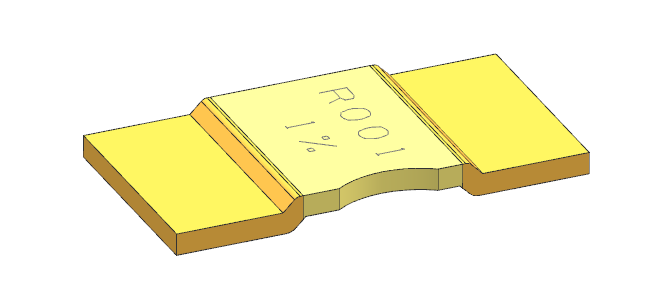
On the surface of a chip resistor, the resistance value is represented by three digits, where the first and second digits are significant numbers, and the third digit represents the number of zeros connected afterwards. When there is a decimal point, it is represented by "R" and occupies one significant place. The nominal resistance code representation method is shown in Table 3.
3. There are 4 levels of tolerance for surface mount resistors (carbon film resistors), namely F level, ± 1%; G level, ± 2%; Grade J, ± 5%; K level, ± 10%.
4. The temperature coefficient of surface mount resistors has 2 levels, namely level w, ± 200ppm/℃; X-grade, ± lOOppm/℃. Only resistors with a tolerance of F-level are used with X-level, while resistors with other tolerance levels are generally W-level.
5. There are mainly two types of packaging: bulk and strip roll packaging.
The working temperature range of surface mount resistors is -55-+125 ℃, and the maximum working voltage depends on the size: 0201 is the lowest, 0402 and 0603 are 50V, 0805 is 150V, and other sizes are 200V.
6. The numbers on the surface of the surface of the chip resistor are arranged horizontally to represent the resistance value, and are specified to be represented by three digits, with the first one being

 Language